Root canal treatment
Settles the pain of an inflamed or infected nerve by cleaning, disinfecting and sealing the inside of the tooth, so that the tooth can be restored and kept for years to come.
Explore this treatmentMelton Mowbray · Leicestershire
Root canal treatment, retreatment and tooth pain care with Angel Ognemirov, MSc Endodontics, for patients in Melton Mowbray and the Vale of Belvoir. Unhurried appointments, a calm approach for anxious patients and one clear aim: keeping your own tooth.
Book an appointment online, or call the practice to speak to someone directly.
Call 0116 270 0550 and say that your symptoms are urgent — severe pain and swelling are seen promptly.
Emergency root canal careEndodontic dentistry
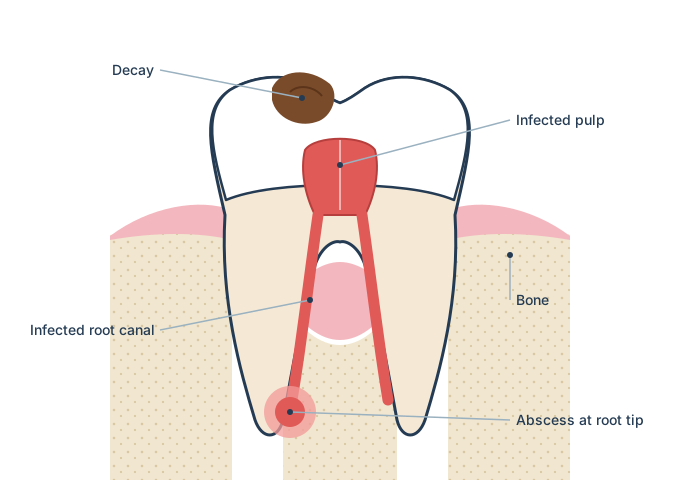
Every tooth is hollow at its centre, with a slender chamber of nerves and blood vessels running the length of each root. When decay, a crack or an injury reaches that chamber, the result is toothache — and, if nothing is done, an infection that spreads into the bone.
Endodontics is the branch of dentistry devoted to this hidden space. Root canal treatment, retreatment of failed root fillings, root-end surgery and the care of cracked and injured teeth all have the same purpose: to remove the problem inside the tooth so that the tooth itself can stay.
Endodontist Melton Mowbray provides this care and nothing else. Your own dentist remains your dentist; we look after the inside of the tooth and return it to them ready to be restored.
Treatments
Root canal treatment in Melton Mowbray, retreatment of teeth treated elsewhere, and answers for pain nobody has yet explained — each service starts with a clear diagnosis and a plan written in everyday language.
Settles the pain of an inflamed or infected nerve by cleaning, disinfecting and sealing the inside of the tooth, so that the tooth can be restored and kept for years to come.
Explore this treatmentFor teeth whose earlier root canal treatment has let infection return: the old filling is removed, hidden canals are found and cleaned, and the tooth is sealed again.
Explore this treatmentA precise, minor surgical procedure to remove persistent infection at the very tip of the root when it cannot be reached through the tooth.
Explore this treatmentA sharp pain on biting often means a crack. Finding it early — and judging how deep it goes — is what keeps the choice between saving and losing the tooth in your hands.
Explore this treatmentKnocked, chipped, loosened or knocked-out teeth need prompt care and patient follow-up, because the nerve inside an injured tooth can die quietly months later.
Explore this treatmentToothache is easy to misread. A careful consultation identifies which tooth is responsible and what it truly needs — which is not always root canal treatment.
Explore this treatmentAn abscess is the body’s reaction to bacteria sealed inside a tooth. Antibiotics quieten it for a while; treating the tooth is what makes it go away for good.
Explore this treatmentThrobbing pain, a sleepless night or a swelling should not wait. Tell us your symptoms are urgent and we will see you promptly, relieve the pain and plan the rest calmly.
Explore this treatmentTold a tooth has to come out? Let us take a second look. An honest assessment of whether it can be saved, and what each option would involve.
Can my tooth be saved?Your visit
Telephone the practice to book a consultation. Let us know if you are in pain, whether your dentist has seen the tooth and if there are recent X-rays.
We listen, examine and test the tooth and take any X-rays required. You leave with a written diagnosis, a plan and the fee — or the reassurance that no treatment is needed.
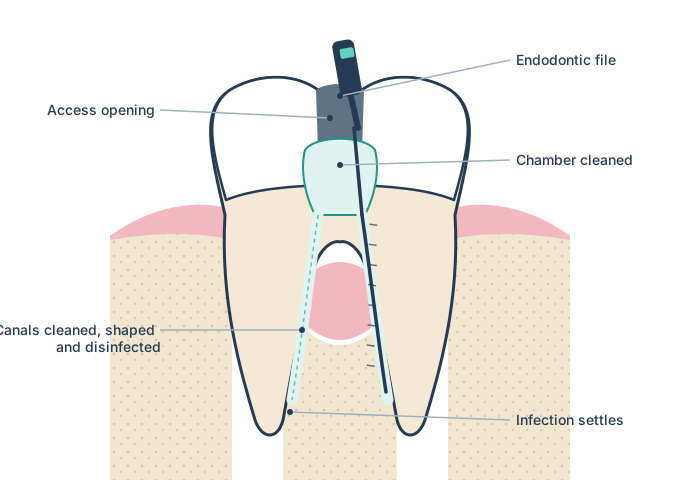
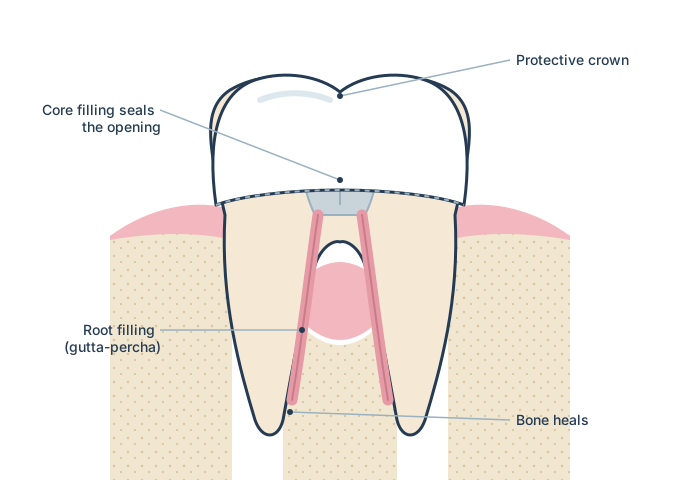
Under local anaesthetic, the canals are cleaned, disinfected and sealed, usually in one visit. Emergency patients are made comfortable first and finished at a later visit.
Your dentist fits the crown or filling that protects the tooth. A later X-ray confirms that the bone around the root has healed, and your dentist receives our report.
Emergency care
Pain that arrives on its own, lingers after a hot drink or pulses at night is the sign of a nerve that is inflamed or has died. Painkillers soften it for a few hours; they do not treat it, and an infection left alone can spread.
Tell us your symptoms are urgent. We will see you as promptly as we can, take the pain away and then plan the rest of the treatment at a time that suits you.
Seek medical help at once if a swelling is spreading quickly, swallowing or breathing is difficult or you feel very unwell: contact NHS 111 or go to A&E.

About me
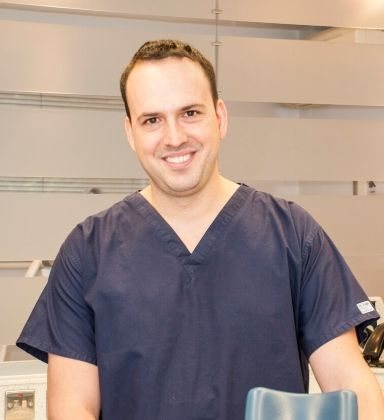
Angel Ognemirov is an endodontist who trained to MSc level in Endodontics at the University of Chester. He has also completed oral and intravenous dental sedation training at Guy's Hospital in London, and holds a certificate in Restorative Dentistry.
His practice has a clear emphasis: root canal treatment carried out thoroughly and explained plainly, in an atmosphere that puts nervous patients at ease. Many of the people he treats have avoided the dentist for years; the appointment is paced to suit them, nothing happens without warning, and comfort is checked throughout.
Angel is an active member of the Society for the Advancement of Anaesthesia in Dentistry (SAAD). Modern endodontic technique is combined with a patient-centred approach, so that the treatment is precise and the experience is calm.
Above all, his work is about preservation — relieving pain, removing infection and keeping natural teeth for patients from Melton Mowbray, the Vale of Belvoir and across Leicestershire and Rutland.
Modern endodontics
Root canals are tiny, curved and often more numerous than they appear. The usual reasons a treatment fails are a canal that was missed, a root filling that stopped short of the tip or a seal that leaked — all matters of detail.
Contemporary endodontic practice addresses each of them: magnification to see the floor of the tooth clearly, electronic measurement of each root, flexible instruments that follow the natural curve of the canal, and disinfectant carried into the fine branches that instruments cannot reach.
No clinician can promise an outcome, and we will not. What careful technique does is give your tooth the best possible chance of healing and lasting.
Precision is not a flourish; it is the whole difference between a tooth that lasts and one that does not.
Keeping your tooth
A tooth that has become infected, or whose root canal treatment has failed, is not automatically a lost tooth. Many can be treated or retreated and go on to serve for years.
We examine the tooth on its own merits — how much sound structure remains, whether there is a crack, the state of the bone around it and what the canals look like — and give you a written view of the realistic options and their likely success.
If extraction really is the right answer, we will tell you so and help your dentist plan the replacement. If the tooth can be saved, we will show you how.
Common questions
Honest answers to what patients ask before they book. The patient guides cover each subject in more depth.
A dentist who concentrates on the inside of the tooth: the nerve, the root canals and the infections that follow when they are damaged. The work includes root canal treatment, retreatment, root-end surgery and the care of cracked and injured teeth, always with the aim of keeping the natural tooth.
You do not need to know in advance — that is what the consultation is for. Lingering pain to hot or cold, toothache that starts by itself, tenderness on biting, a swelling or a tooth that has darkened are all reasons to be assessed, but only testing can confirm the cause.
With the tooth properly numbed, no. You will feel pressure and vibration rather than pain, and we stop and top up the anaesthetic if you feel anything sharp. Some tenderness for a few days afterwards is normal and eases with ordinary painkillers.
Typically one appointment of 60 to 90 minutes. A badly infected tooth, a retreatment or unusual anatomy may need a second visit a week or two later.
Rarely, when the tooth can be saved. Replacing a tooth takes longer, costs more over time and never quite matches the original. Extraction is the right choice only when a tooth cannot be restored predictably — and we will tell you honestly if that is the case.
Your dentist places the permanent restoration, usually a crown on a back tooth, within a few weeks. The tooth may feel bruised for a few days and then behaves like any other. We review healing on an X-ray later and send your dentist a report.
No. Many patients contact us themselves. If your dentist has already seen the tooth, let us know what they found; we will write to them after your visit.
Every dentist is trained in root canal treatment. A practice devoted to endodontics does this work every day, with the time, magnification and techniques it demands, which matters most for molars, retreatments, cracks and cases that have already proved difficult. Note that in the UK only dentists on the General Dental Council's specialist list may call themselves specialists.
They may reduce a swelling for a while, but they cannot reach the bacteria sealed inside a dead tooth. The infection returns once the course ends; only treatment of the canal system removes the cause.
Fees depend on the tooth and the complexity of the work, so the exact figure is confirmed in writing after your consultation and before any treatment begins. It will not change part-way through.
Telephone the practice. Say whether you are in pain, whether your dentist has seen the tooth and if you have recent X-rays, and we will arrange a consultation at the earliest suitable time. The contact page has the details.
Book an appointment
Referred by your dentist, looking for a second opinion or in pain today — book an appointment online or call the practice and speak to someone directly. If you are in pain, say so and you will be seen as soon as possible.
Severe pain or a swelling? Let us know when you ring and we will find you the earliest possible time.